
Class 5 Worksheet on Proverbs Look Before You Leap

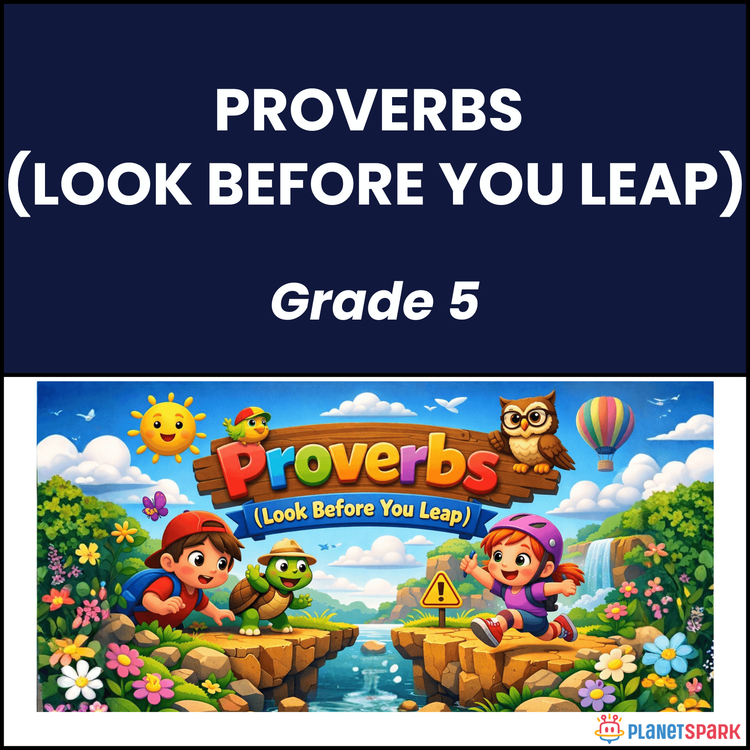
Class 5 Worksheet on Proverbs Look Before You Leap
Wisdom in Words: Mastering the Proverb "Look Before You Leap" for Grade 5
This Grade 5 worksheet introduces students to the timeless proverb "Look Before You Leap," which teaches the valuable lesson of thinking carefully before taking action. Proverbs are short, well-known sayings that offer wisdom and advice. Through focused practice with this proverb and several others, students will learn to understand, interpret, and apply these wise sayings to real-life situations, enriching both their language skills and their decision-making.
Why Mastering Proverbs Matters in Grammar?
For Grade 5 students, understanding proverbs is essential for cultural literacy and effective communication. This topic is important because:
1. Proverbs appear frequently in literature, conversations, and media, conveying wisdom in memorable phrases.
2. Learning proverbs helps students understand abstract concepts like caution, patience, and perseverance.
3. Using proverbs appropriately makes writing and speech more sophisticated and impactful.
What's Inside This Worksheet?
This worksheet includes five targeted activities to build deep understanding of proverbs:
Exercise 1 – Underline the Words
Students read literal descriptions of cautious behavior and underline the actions that reflect the meaning of "Look Before You Leap." This builds recognition of when the proverb applies.
Exercise 2 – Multiple Choice Questions
Students read various proverbs and choose their correct meanings from three options. This classic format builds understanding of multiple common proverbs.
Exercise 3 – Sentence Rewriting
Students are given scrambled words that need to be rearranged to form the complete proverb "Look Before You Leap." This reinforces memorization of the exact phrasing.
Exercise 4 – Fill in the Blanks
Students complete a passage by choosing the correct word from two options, applying the lesson of "Look Before You Leap" in a narrative context.
Exercise 5 – Paragraph Writing
Students write a short paragraph explaining a proverb they know and how it applies to real life, demonstrating independent understanding and application.
🔹 Answer Key
Exercise 1 – Underline the Words
1. looked before he jumped
2. checked the water first
3. planned his trip carefully
4. watched for danger
5. thought about her answer
6. tested the step before standing
7. read the question twice
8. waited before crossing the road
9. measured the wood
10. considered all the choices
Exercise 2 – Multiple Choice Questions
1. c) Think carefully before acting.
2. b) Rushing causes mistakes.
3. a) Fix problems early.
4. b) Consistent effort succeeds.
5. b) What you do matters more.
6. b) Being early brings success.
7. a) Determination finds solutions.
8. c) Save small, waste large.
9. a) Great work takes time.
10. c) Appearances can deceive.
Exercise 3 – Sentence Rewriting
1. Look before you leap.
2. Look before you cross the river.
3. Think before you act.
4. Do not jump without looking.
5. Test the step first, then walk.
6. Think before you decide.
7. Check before you go ahead.
8. See the path before you walk.
9. Think, then you speak.
10. See all options before you choose.
Exercise 4 – Fill in the Blanks
Riya wanted to finish her project quickly. She started working without reading the instructions carefully. Her teacher said, "Look before you leap." Riya then planned her work step by step. She followed the examples given in the book. Her friend Meera advised her to check each page twice. Riya listened to her friend's advice. In the end, she completed it well because she was careful. Her teacher praised her for being thoughtful.
Exercise 5 – Paragraph Writing
Answers may vary. Sample answer: One proverb I know is "Haste makes waste." This means that when you rush through something without thinking, you often make mistakes that cost you more time in the end. For example, last week I was in a hurry to finish my math homework. I did not read the questions properly and made many errors. I had to redo the entire assignment, which took twice as long. If I had taken my time and checked my work, I would have finished faster. This proverb teaches me to slow down and be careful rather than rushing.
Help your child master proverbs and learn valuable life lessons through a Free 1:1 Communication Skills Trial Class at PlanetSpark.
Frequently Asked Questions
It means thinking carefully before acting to avoid mistakes or problems later.
Proverbs teach moral lessons and improve understanding of figurative language in context.
They can plan ahead and make thoughtful decisions instead of acting quickly.