
Class 5 Worksheet on Apostrophes in Compound Nouns

Class 5 Worksheet on Apostrophes in Compound Nouns
Possession Perfected: Apostrophes in Compound Nouns for Grade 5
This Grade 5 worksheet focuses on mastering apostrophe usage in compound nouns, helping students understand how possession works in multi-word nouns like mother-in-law, passer-by, and editor-in-chief. Through structured and engaging exercises, learners build clarity in one of the trickier areas of punctuation.
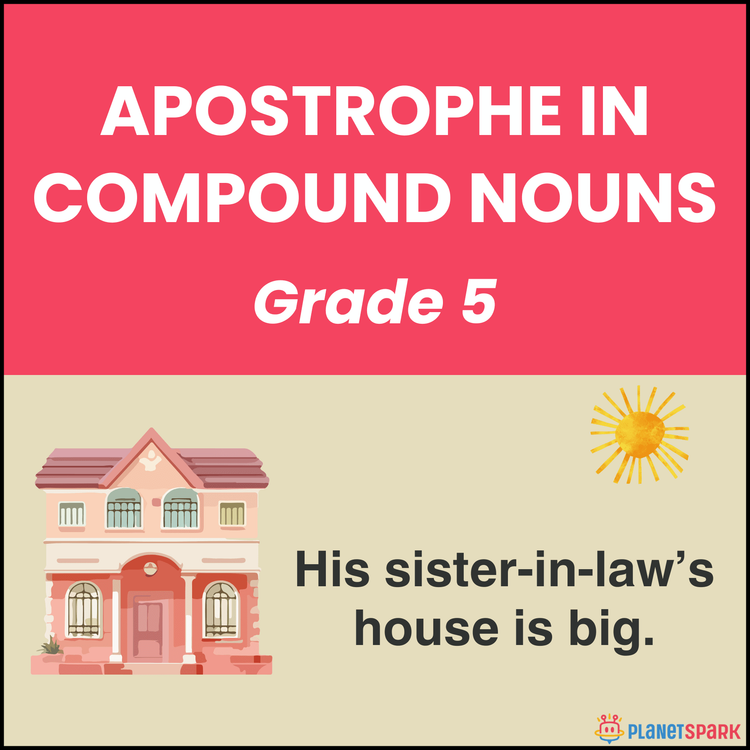
Correct apostrophe usage ensures clarity in showing ownership and helps students avoid common grammar mistakes in both school and real-life writing. Apostrophes are usually added to the last word of a compound noun to show possession, such as “sister-in-law’s house.”
Why Apostrophes in Compound Nouns Matter in Grammar?
Understanding apostrophes in compound nouns is important because:
1. It helps students correctly show ownership in complex noun structures.
2. It builds accuracy in writing formal and everyday sentences.
3. It strengthens punctuation skills and grammar confidence.
4. It prevents common mistakes in multi-word noun usage.
What’s Inside This Worksheet?
This worksheet includes five grammar-rich activities that develop mastery of apostrophes in compound nouns:
Exercise 1 – Multiple Choice Questions
Students choose the correct sentence showing proper apostrophe placement in compound nouns like mother-in-law and runner-up.
Exercise 2 – True or False
Students evaluate statements about apostrophe rules in compound nouns to build conceptual clarity.
Exercise 3 – Add the Apostrophe
Students insert apostrophes correctly in compound noun phrases such as daughter-in-law and attorney general.
Exercise 4 – Sentence Rewriting
Students rewrite sentences by placing apostrophes correctly in compound noun structures.
Exercise 5 – Fill in the Blanks
Students complete a paragraph by adding apostrophes in compound nouns based on context.
Answer Key (For Parents & Educators)
Exercise 1 – Multiple Choice Answers
1. b) My mother-in-law’s house is old.
2. c) The passer-by’s phone rang loudly.
3. a) My aunt-in-law’s farm is large.
4. c) The editor-in-chief’s chair is big.
5. a) My brother-in-law’s bike is fast.
6. a) My father-in-law’s office is busy.
7. b) The maid-of-honor’s speech was lovely.
8. c) His son-in-law’s shop is crowded.
9. a) The commander-in-chief’s rule was strict.
10. b) The runner-up’s medal was bright.
Exercise 2 – True or False
1. True
2. True
3. False
4. True
5. False
6. False
7. True
8. False
9. True
10. False
Exercise 3 – Add the Apostrophe
1. The attorney general’s meeting
2. His daughter-in-law’s car
3. Her sister-in-law’s relatives
4. Her great-grandmother’s ring
5. The secretary general’s officers
6. A ten-year-old’s bicycle
7. The attorney-at-law’s advice
8. A grown-up’s job
9. That six-year-old’s drawing
10. The runner-up’s trophy
Exercise 4 – Sentence Rewriting
1. Your great-grandfather’s watch
2. His step-mother’s office
3. That seven-year-old’s bicycle
4. The vice president’s vote
5. The merry-go-round’s music
6. Jack-o’-lantern’s funny face
7. Her brothers-in-law’s cars
8. The vice principal’s rules
9. The secretary-treasurer’s report
10. The six-year-old’s pencil box
Exercise 5 – Fill in the Blanks
1. mother-in-law’s
2. sister-in-law’s
3. passer-by’s
4. great-grandfather's
5. ten-year-old's
6. runner-up’s
7. father-in-law’s
Help your child master tricky apostrophe rules in compound nouns with confidence and accuracy through guided practice and expert-designed activities.
Frequently Asked Questions
When compound nouns are possessive, add an apostrophe to the second noun, such as "brother-in-law’s book."
Yes, they may forget to place the apostrophe in the correct position or misuse it when two nouns are joined by a hyphen.
Encourage students to identify compound nouns in sentences and practice adding apostrophes correctly, like "mother-in-law’s idea."